In short
- An average tells you who to talk to, not what to say. Coaching needs the criterion that keeps failing and the words on the call where it failed.
- InsightCallIQ keeps both: every QA answer quotes its turn, so each agent's page lists their criteria weakest first and their coaching moments with the transcript clip.
- The coach agent finds repeated misses (a criterion answered no on at least two scored calls), picks the top three, and proposes a plan with the clips.
- The team lead decides. The proposal waits at Ask first; accepting it creates a draft plan that the lead agrees with the agent.
A coaching session that opens with “your QA average dropped this month” usually goes nowhere. The agent asks which calls, the team lead scrolls through a spreadsheet, and the conversation drifts to whether the scorecard is fair. Twenty minutes later, nobody has listened to a single moment of a call.
The fix is not a better average. It is evidence at the level coaching happens: one criterion, one call, one turn, in the agent's own words. This post walks from the coaching overview in InsightCallIQ down to a single moment, then to the plan the coach agent prepares, using the fictional Harbourline Financial demo: 25 agents in three teams.
Start wide: who needs attention
The Coaching page lists every agent over the last 30 days: calls handled, QA average, the trend (the last seven days against the weeks before), the pass rate, auto-fails, compliance misses, customer sentiment at the end of the call, average handle time and any open coaching plan. Every figure is counted from stored, scored calls. Nothing is sampled, because every call was scored.
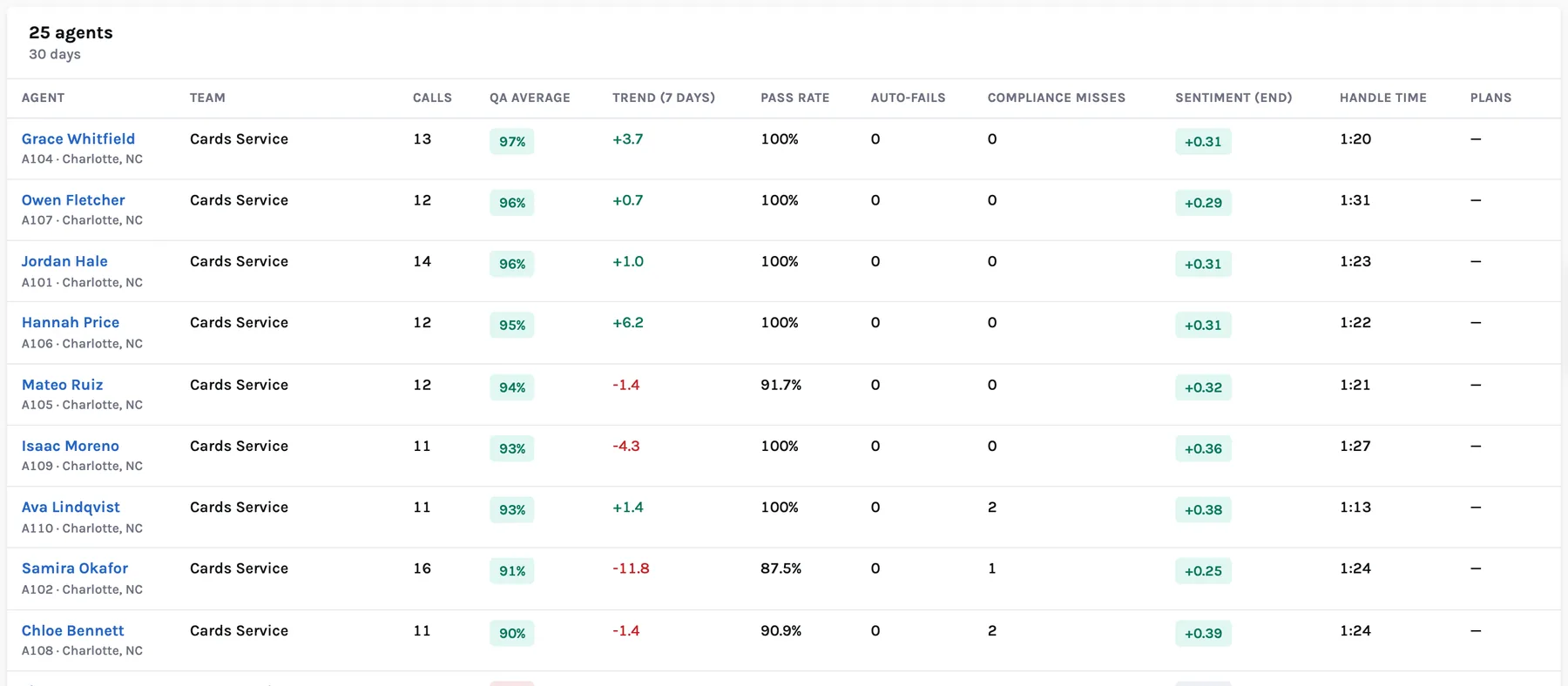
On the demo floor one row stands out in Cards Service: Liam Carter has the lowest QA average on the floor, a steep negative trend and the most compliance misses. In Collections & Hardship, Victor Hughes and Tyler Grant sit well below their team. These rows are where a team lead should look first. But notice what the table cannot tell you: whether Liam's problem is one habit repeated on every call or a dozen different slips. Those need very different conversations.
Leaderboards, used carefully
The Leaderboards tab ranks each team by QA average, then by fewer compliance misses, then by sentiment. It is useful for spotting who to ask to share how they handle a hard call type. It is a poor way to coach the bottom of the list, which is why the agent page exists.
Go narrow: the criteria, weakest first
Open an agent and the page changes from ranking to diagnosis. The weekly trend shows QA average and compliance misses for the last four weeks. Beside it, every scorecard criterion the agent was scored on, sorted by the share answered yes, weakest first.
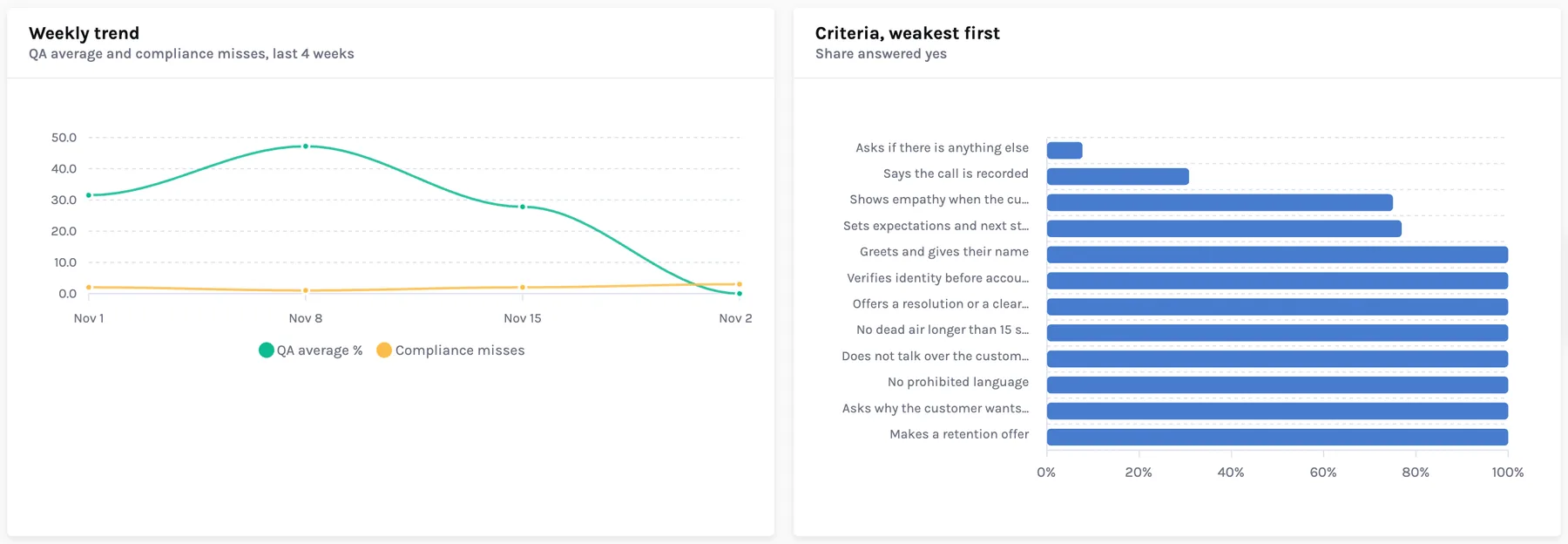
For Liam the picture is now specific. Two criteria fail far more often than the rest: asks if there is anything else at the close, and says the call is recorded in the opening. Empathy and setting next steps are weaker than ideal but mostly fine. Greeting, identity verification, resolution, dead air and interruptions are answered yes almost every time. This is not an agent who is bad at the job; it is an agent who has dropped two scripted lines. One of them, the recording disclosure, is an auto-fail criterion on the service scorecard, which is why his average collapsed rather than slipped.
QA average far below the team; trend sharply down. The conversation starts with a number the agent cannot connect to anything they did.
Two criteria, both scripted lines, fail on most calls; everything about handling the customer is fine. The conversation starts with two sentences to put back.
Go to the call: coaching moments
A criterion is still abstract. The moment is not. Because every QA answer in InsightCallIQ quotes the transcript turn it rests on, each failed answer and each compliance miss becomes a coaching moment: the criterion, the call, the time in the call, the quoted words and a one-line explanation. The agent page lists the latest of them.
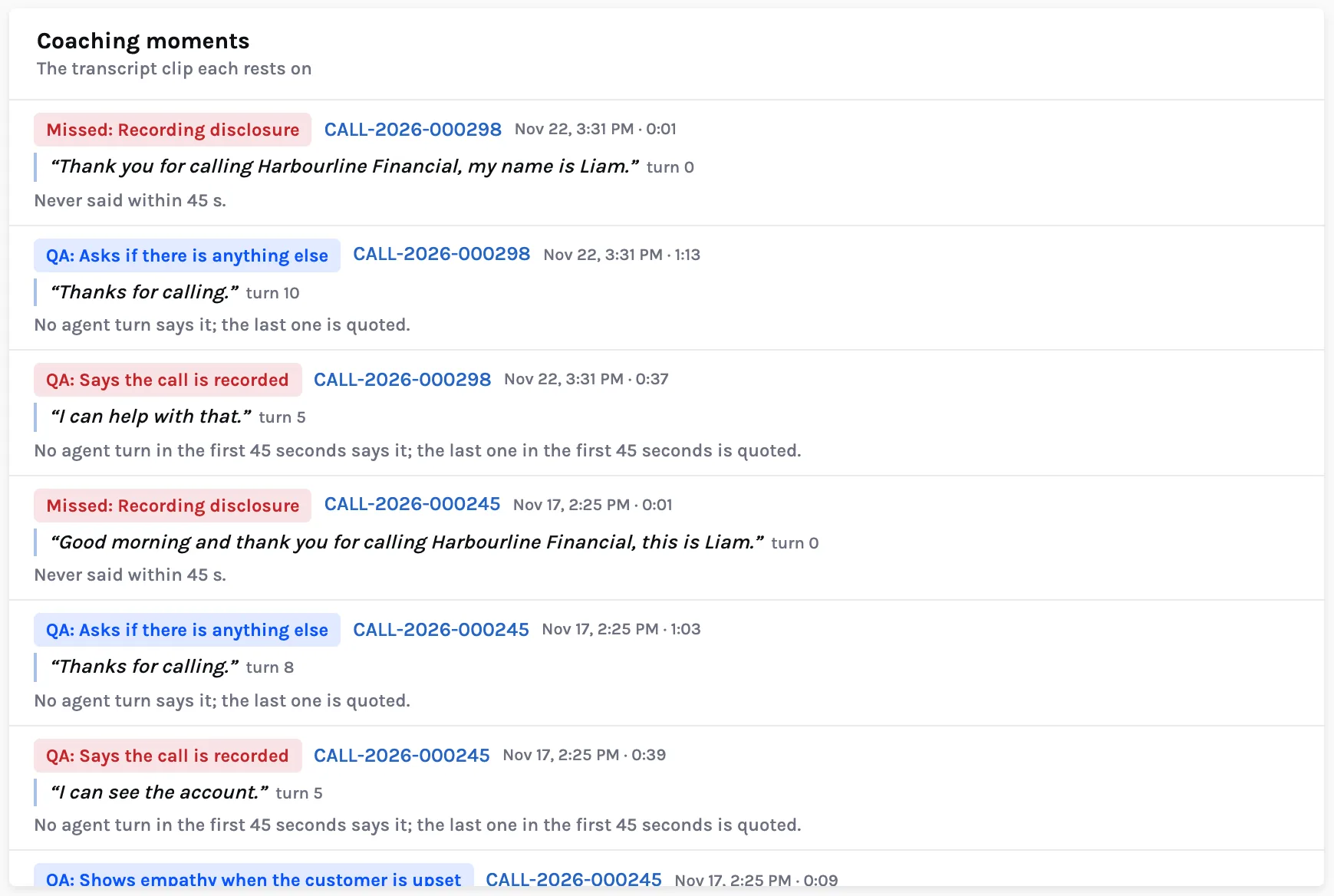
Read a few and the pattern is obvious. The opening line is a friendly greeting with his name, and then the call moves straight on: the recording notice is never said in the window the requirement allows. At the close, the last agent turn is “Thanks for calling.” with no question in front of it. The moment quotes the line that was said, which is often more useful to an agent than being told what was missing: they can hear themselves, and see exactly where the missing sentence belongs.
Each moment links to its call, where the team lead and the agent can read the whole transcript, see the timeline and jump to the moment in context. If the agent thinks a scorecard answer is wrong, they can dispute it from the call; the dispute becomes a review that a second person decides. That keeps the coaching conversation on behaviour and moves arguments about the scorecard somewhere they can be settled properly.
The coach agent's proposal
Finding the pattern by hand works for one agent. For a floor, InsightCallIQ's coach agent (one of 8 agents in the catalogue) does the first pass on every call it runs on.
The coach agent's step: repeated misses only, the three most frequent, with the quotes. A person accepts the plan.
The rules are deliberately simple and readable:
- It looks at the agent's scored calls in the 30 days before the call it is running on.
- It counts each criterion answered no, keeping up to three quoted clips per criterion.
- It keeps only repeated misses (no on at least two calls), because a single slip is not a coaching topic, and takes the three most frequent.
- Each focus line states the evidence as a fact: the criterion, answered no on so many of so many scored calls.
- If the agent already has an open plan, it proposes nothing, so leads are not flooded with duplicates.
The proposal waits for a person. Proposing a coaching plan is capped at L2 (Ask first) whatever the autonomy dial says. When the team lead accepts, InsightCallIQ creates a draft plan on the Coaching page: the focus criteria, the clips, a goal of answering yes on each focus criterion on the agent's next scored calls, a due date a few weeks out and the team lead as owner. The lead then agrees it with the agent and marks it active. On the demo, two plans exist: one still a draft, one already active.
Why the agent can't just open the plan
A coaching plan is a conversation between two people. The coach agent is good at finding the evidence; it is not in a position to judge whether the agent was covering a complex call, is new to a queue, or has already been spoken to. So it prepares, and the team lead decides.
Running the coaching session
gate
watch
The last step is what changes when every call is scored. With sampled QA, an agent coached on Monday might not have a call reviewed for weeks, and the plan is judged on a handful of calls. With every call scored, the criteria chart and the moments update as soon as the calls are in, and the lead can see on the agent page whether the two missing lines have come back.
Agents who look fine on average
The same approach catches the opposite case. An agent with a high average can still have one criterion that fails repeatedly, hidden by everything they do well. On the demo, an agent on Fraud & Disputes with a strong average has an active plan on setting expectations and showing empathy; another has a draft plan on next steps. Neither would have been coached from a ranking. The coach agent found them because it looks for repeated misses, not low averages.
Coach the moment, not the mean.
Averages are for finding who to talk to. Criteria, weakest first, are for deciding what to talk about. Moments, with the quote, are what you actually talk about. InsightCallIQ keeps all three, from the same scored calls, and leaves the conversation to the team lead.
Where people stay in charge
- A person decides every review: a compliance breach, a fraud alert, a QA dispute, a complaint or a vulnerable customer. When the controls refer it, a lead who did not submit it decides.
- Agents prepare and ask first: every agent action is capped at L2, so a wrap-up note, a calibration request, a watch-list entry or a weekly brief waits for a person to accept it.
- Every score is the engine's: points come from the scorecard's weights and the risk model's reasons, and a drafted sentence with a figure outside the call's facts is thrown away.
- A QA answer stands on a quote: a model answer whose quote is not word for word in the transcript is rejected, and the scorecard's own check stands.
- The coach agent proposes a plan with its evidence; the team lead accepts, edits or rejects it, and agrees the plan with the agent.