In short
- “Why are customers calling?” has three layers: the reason for the call, what customers actually say about it, and the cause behind the complaints and the calls that come back.
- InsightCallIQ counts all three from every call: themes by call reason with their change on the prior period, the phrases each theme's customers use more than anyone else, complaint root causes with a quote, and repeat contacts within a week.
- Every figure is counted, every phrase is quoted. The insights analyst drafts a weekly brief from those counts; a person publishes it.
- The copilot answers from the same figures, read-only, with the calls behind each answer.
Every contact-centre leader has a top-ten list of call reasons. It is usually built from disposition codes the agents pick at the end of a call, in a hurry, from a menu that was designed years ago. It tells you that a lot of people called about “billing”. It does not tell you that half of them were charged twice by the same merchant, or that the same customers rang back three days later because nothing had changed.
InsightCallIQ answers the question from the calls themselves. This post works through the Insights page on the fictional Harbourline Financial demo, layer by layer, and ends with the weekly brief and the copilot, so you can see how an operations lead gets from “volumes are up” to a cause somebody can fix.
Layer one: the reason for every call
Every call gets a call reason from the transcript, not from a disposition code. A lexicon of short phrases (one to six words per entry) scores each reason in the taxonomy, weighting the customer's words above the agent's and the start of the call above the end, because that is where people say why they rang. A language model can propose a different reason, but its proposal is kept only if the reason is in the taxonomy and it quotes a turn of the transcript word for word; otherwise the lexicon's reason stands, and the call says so. The reason sits on every call with its confidence and the phrases that produced it.
That alone fixes the biggest problem with disposition data: it is consistent. The same words produce the same reason on every call, on every team, every day.
Three layers from the same calls: themes, what customers say, and the causes behind complaints and repeat calls.
Layer two: themes, and what customers say
The Themes tab groups the period's calls by reason. For each theme it shows the number of calls and their share, the count in the prior period of the same length, end-of-call sentiment, the QA average, complaints, outcomes (resolved, unresolved, escalated, saved, cancelled) and, most usefully, what customers say most.
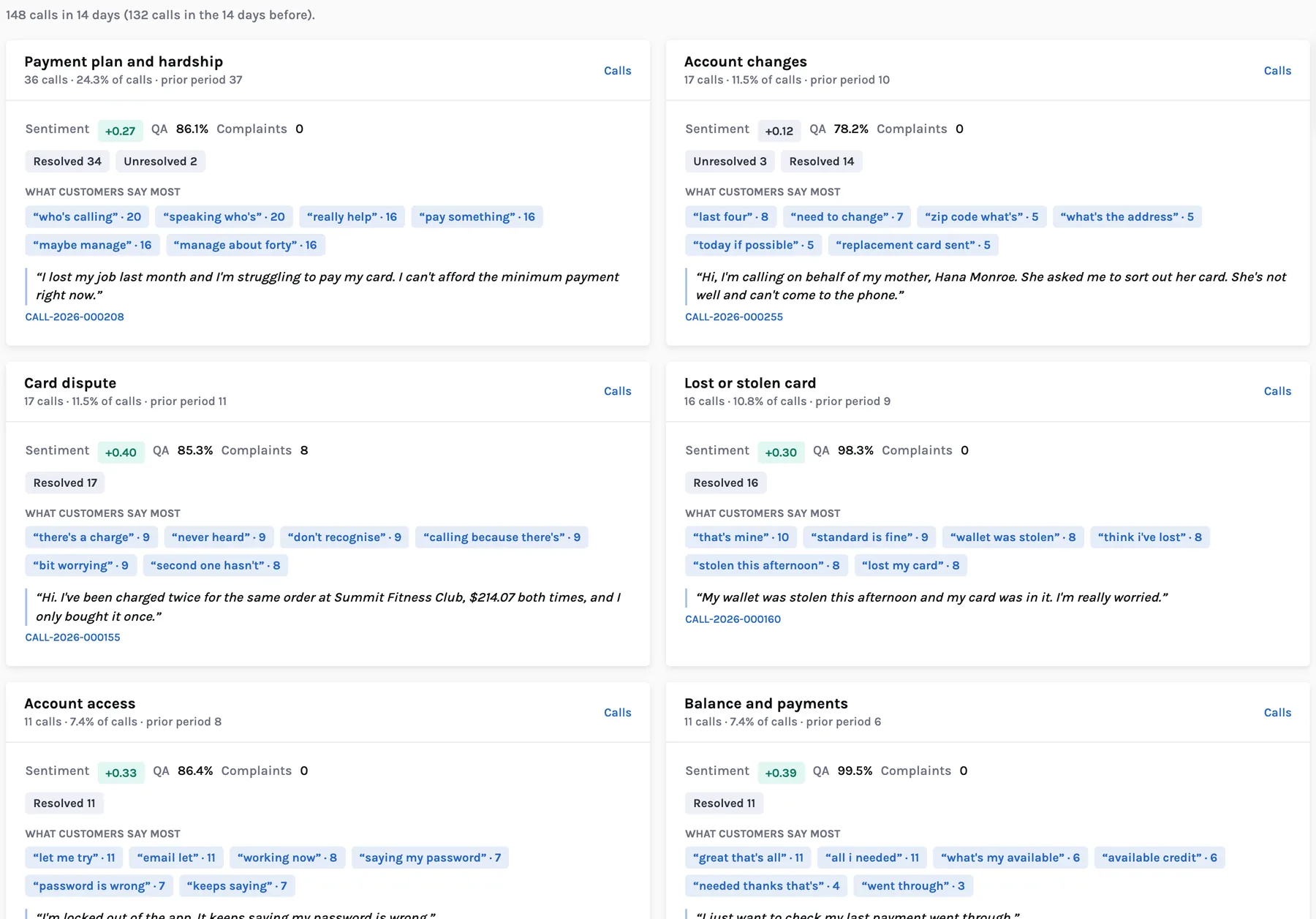
The phrases are worth understanding, because they are where root causes start. For each theme, InsightCallIQ takes the two- and three-word phrases from the customers' turns, keeps those that appear in at least two of the theme's calls, and ranks them by lift: how much more often this theme's customers say them than callers in general. Phrases that most callers say (greetings, “thank you”, the scripted lines) drop out. Each card also carries one customer quote, linked to its call.
On the demo, the card dispute theme reads like a diagnosis: “there's a charge”, “never heard”, “don't recognise”, “second one hasn't”, and a quote from a customer charged twice for the same order at a (fictional) gym. Payment plan and hardship, the largest theme, is about not being able to pay this month. Account changes carries a different signal altogether: “last four”, “need to change”, “what's the address”, and a quote from someone calling on behalf of their mother. That last pattern is one the fraud analyst cares about too; on InsightCallIQ the same calls feed both views.
Read the phrases, not just the counts
A theme that grew is a question. The phrases are often the answer: a new merchant name, a feature that stopped working, a letter customers did not understand. Because each phrase is counted in calls, not mentions, one angry caller repeating themselves cannot push it up the list.
Layer three: root causes and the calls that come back
The Root causes tab answers the questions a complaints manager and an operations lead ask next.
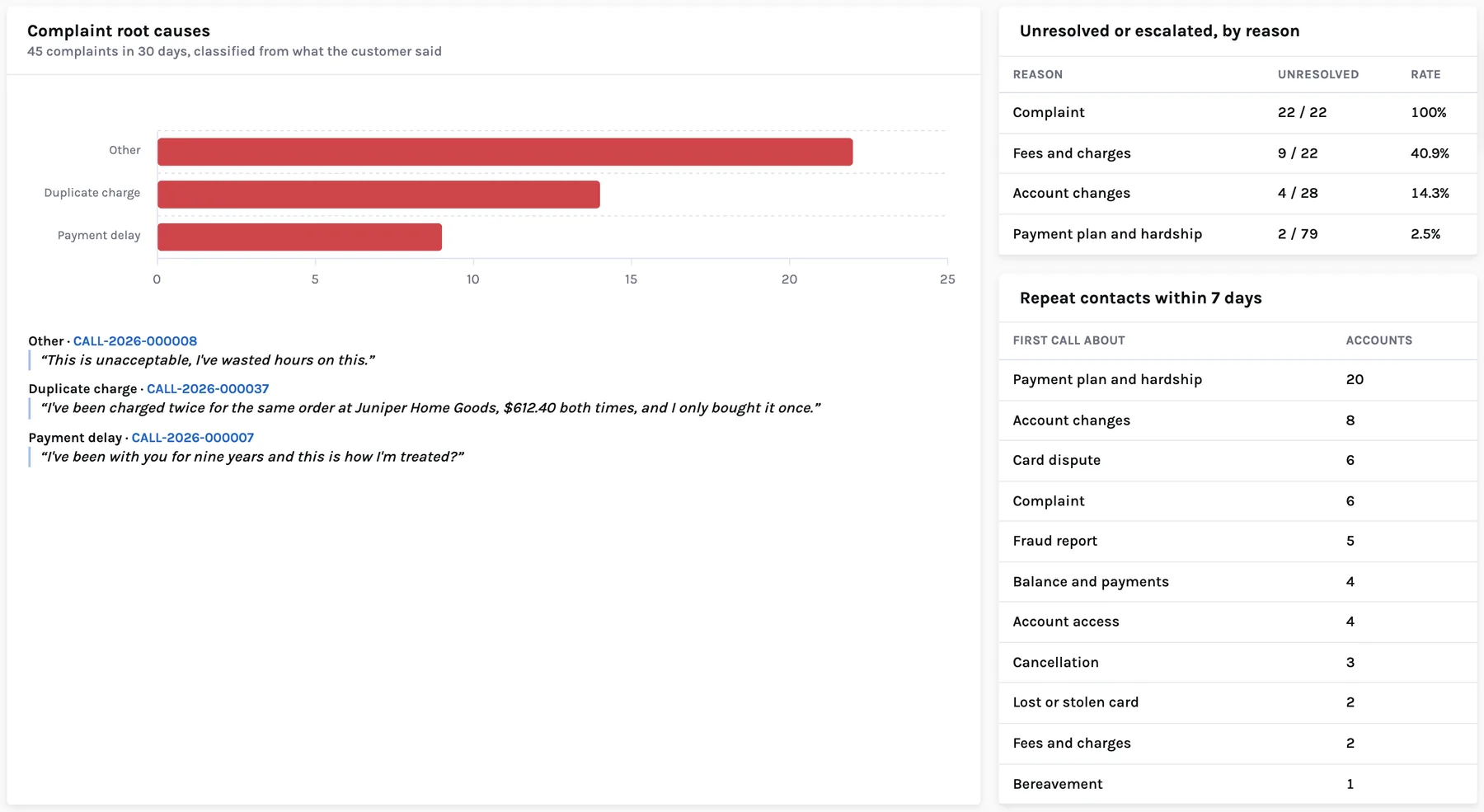
- Complaint root causes. Every call is run through the same complaint classifier InsightService uses. A call that is a complaint gets one or more root causes (a duplicate charge, a fee charged in error, a payment delay, poor communication, staff conduct, a process failure and so on), and the tab counts them with an example quote for each. On the demo, the named causes at the top are duplicate charges and payment delays, each with a customer's own sentence.
- Unresolved or escalated, by reason. For each reason, how many calls ended unresolved or escalated, out of how many. This is where a reason with modest volume but a poor resolution rate shows up; on the demo, fees and charges calls go unresolved far more often than their volume suggests.
- Repeat contacts within seven days. Accounts that called again within a week, grouped by the reason for the first call. A repeat contact is the clearest sign that the first call did not fix the problem. On the demo, payment plan and hardship calls bring customers back most often.
Put the three together and you have a short list of things to fix. The duplicate-charge complaints point at a merchant or a processing step. The unresolved fees and charges calls point at what agents are allowed to do on the call. The repeat hardship calls point at what the customer was told would happen next. None of these appears in a disposition-code report.
| Question | Where the answer is | What makes it trustworthy |
|---|---|---|
| What are customers calling about, and is it changing? | Themes: calls, share, prior period | The reason is read from the transcript the same way on every call |
| What exactly are they saying? | Themes: what customers say most, the quote | Phrases ranked by lift, counted in calls; each quote links to its call |
| Why do they complain? | Root causes: complaint causes | The complaint classifier, with an example quote per cause |
| What doesn't get fixed? | Root causes: unresolved by reason, repeat contacts | Outcomes on every call; repeat contacts by account within a week |
| Is it one site or everywhere? | Sites | The same figures by agent location |
The weekly brief: drafted from counts, published by a person
Operations leads do not read dashboards every morning; they read a short note. The insights analyst, one of InsightCallIQ's 8 agents, prepares it. Prepare this week's brief counts the period's calls and writes the brief's lines from those counts: the headline (how many calls, and what most were about), the top four reasons each against the prior period, the QA average against the prior period, how many calls missed a compliance requirement, how many carried a high fraud risk, and the complaints and vulnerable customers.
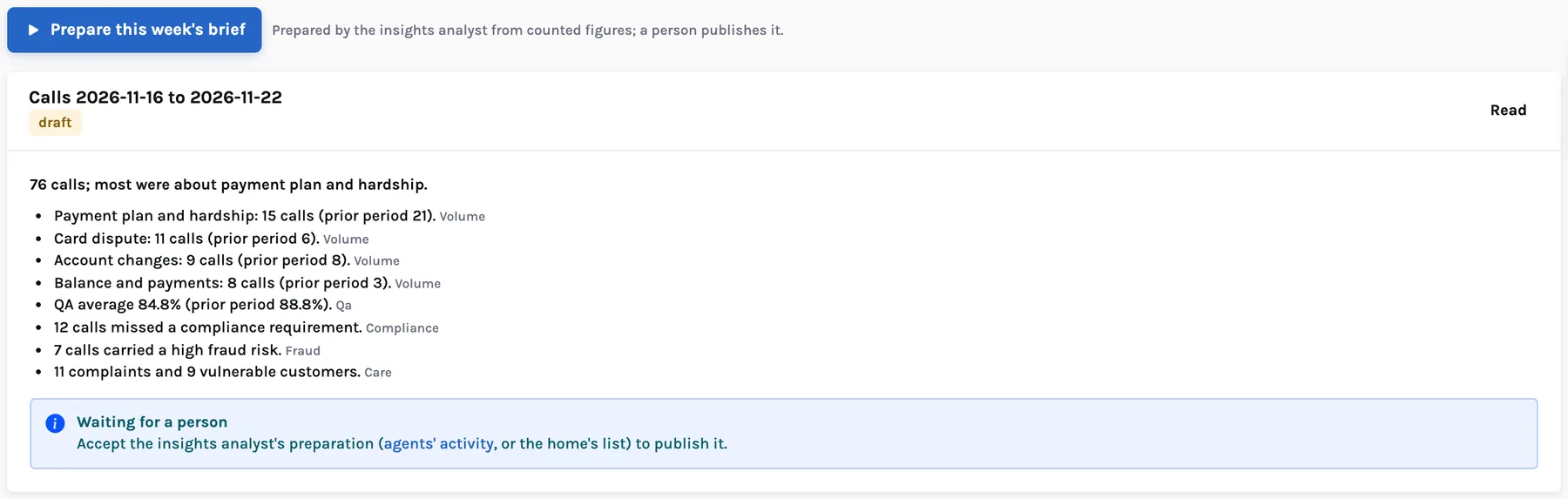
Every line is a figure the engine counted; when a language model phrases the brief, a sentence carrying a number that is not in the counted facts is thrown away and the counted wording stands. Publishing the brief is capped at L2 (Ask first): the draft waits until a person accepts the insights analyst's preparation, from the agents' activity or the home page.
Asking the calls directly
Sometimes the question is not on any tab. The Insights page's Ask your calls copilot reads the calls' transcripts, scores, compliance results, fraud links and trends through read-only tools, and answers with its sources. Every name and figure it gives is checked against what it read. With the model switched off, as on the demo, it answers from the figures directly and says so.
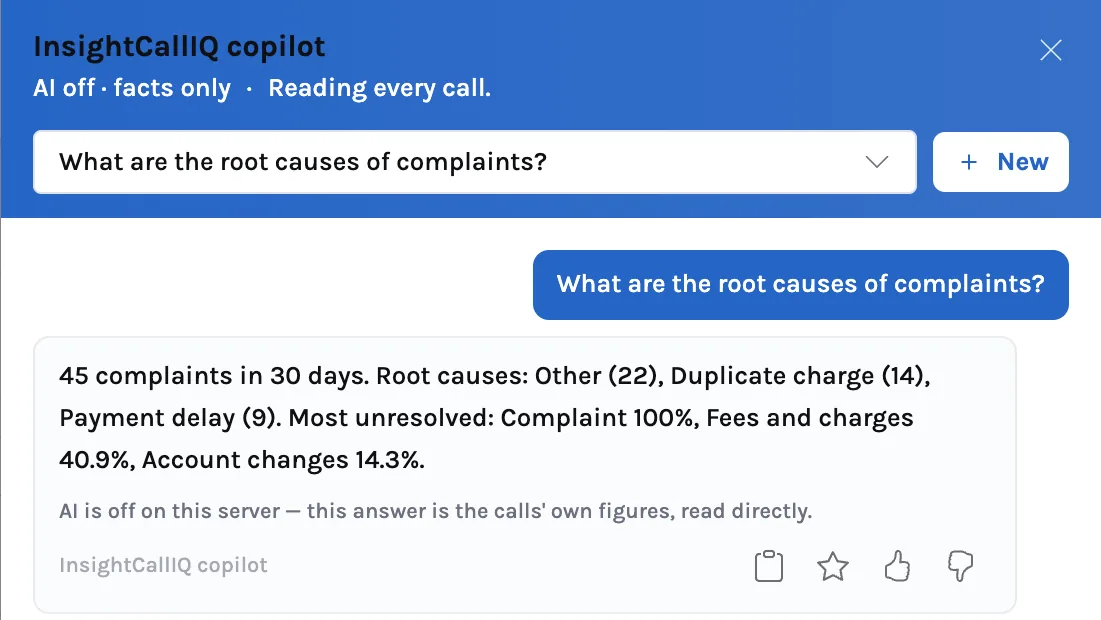
The suggested questions are the ones operations leads ask most: why customers are calling this week, which fraud rings are active, where required disclosures are being missed, what customers are saying about late fees, and the root causes of complaints. The copilot never changes anything; it reads.
A weekly root-cause routine
watch
watch
The point of the routine is the gate in the middle. Insight that does not become a named fix with an owner is just a nicer chart. Because every theme, cause and repeat contact links back to calls, the owner of a fix can read exactly what customers said, and judge it themselves.
Count every call. Quote the customer. Let a person decide what to fix.
Themes say what customers call about; their phrases say what is actually happening; root causes and repeat contacts say what is not getting fixed. InsightCallIQ counts all of it from the calls, quotes it, and drafts the brief. People decide what changes.
Where people stay in charge
- A person decides every review: a compliance breach, a fraud alert, a QA dispute, a complaint or a vulnerable customer. When the controls refer it, a lead who did not submit it decides.
- Agents prepare and ask first: every agent action is capped at L2, so a wrap-up note, a calibration request, a watch-list entry or a weekly brief waits for a person to accept it.
- Every score is the engine's: points come from the scorecard's weights and the risk model's reasons, and a drafted sentence with a figure outside the call's facts is thrown away.
- A QA answer stands on a quote: a model answer whose quote is not word for word in the transcript is rejected, and the scorecard's own check stands.
- The weekly brief is drafted from counted figures and published only when a person accepts it; the copilot reads and answers, and changes nothing.