In short
- A voiceprint is a short vector that summarises how a voice sounds. InsightCallIQ compares the caller's voice with the account holder's enrolled voiceprint and with every watched voice, by cosine similarity.
- A voice match is evidence, not identity. It adds points to the fraud score with a sentence saying why, alongside everything else on the call; it never decides anything by itself.
- The watch list holds numbers, devices, voices and accounts your team has confirmed as fraud. Only a lead can add or remove an entry, and each needs a reason that goes on the audit trail.
- Entries reach the list from a confirmed fraud review, where the lead ticks what to watch, or by hand from the Fraud page. An agent can prepare an entry; it cannot add one.
Two tools that are easy to misuse
Voice biometrics and watch lists are the most powerful fraud tools in a contact centre, and the easiest to misuse. A voice comparison treated as proof turns a cold into a fraud flag. A watch list nobody owns becomes a list of grudges that adds points to innocent callers for years.
InsightCallIQ treats both as evidence with an owner. This post walks through how each works in the product, using the fictional Harbourline Financial demo, and the rules that keep them honest.
How a voiceprint is made and compared
Every voiceprint comes from one interface: give it a stretch of telephone audio, get back a normalised vector. Two embedders sit behind that interface, and an environment setting chooses between them:
| Embedder | What it is | When to use it |
|---|---|---|
| Acoustic (the default) | No model. Frame energy, zero-crossing rate, a filter bank across the telephone band and pitch from autocorrelation, each summarised by its mean and spread. The same audio always gives the same vector. | Everywhere, with no model to host. Deterministic, so a score can be reproduced from the recording. |
| ECAPA-TDNN | A speaker-embedding model (SpeechBrain’s ECAPA), an optional dependency the product checks for before using. | When you want a trained speaker model and can run it in your own account. |
Silence carries no voice, so quiet frames are skipped. Comparison is cosine similarity between two vectors. Two thresholds in the fraud pack turn a similarity into a signal:
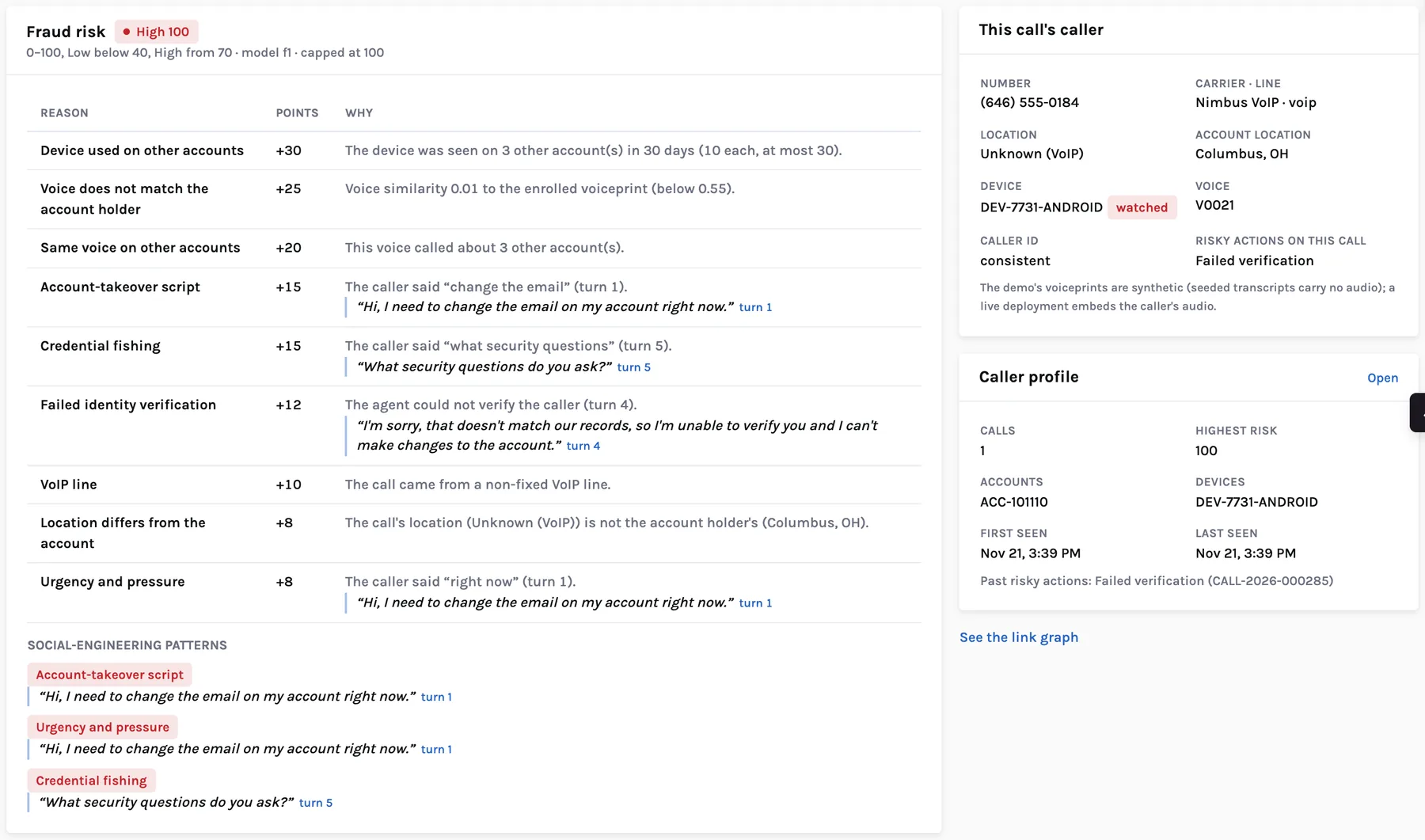
- Mismatch with the account holder: a similarity below 0.55 to the enrolled voiceprint adds points (“voice does not match the account holder”).
- Match with a watched voice: a similarity of 0.82 or more to any voice on the watch list adds more (“voice matches a watched fraudster”).
The same match threshold groups voices across calls. Each call's voice joins the closest existing voice cluster if it is similar enough, or starts a new one. That is how the product can say “this voice called about other accounts”, which on its own is one of the strongest takeover signals there is.
One voice vector, three comparisons; each one that fires becomes a reason on the fraud score, never a verdict.
Demo voiceprints are synthetic
The demo's calls are seeded transcripts with no audio, so its voiceprints come from a synthetic generator: a fictional speaker's vector derived from their key, with a little variation per call. The product says so on every caller panel. With real calls, the embedder reads the caller's audio.
Evidence, not identity
The design principle is written at the top of the voiceprint module: a voice match is evidence, not identity. In practice that means three things.
A voice result is one reason among several. On the demo's takeover call, the voice mismatch adds its points next to a spoofed caller ID, a device seen on another account, the takeover script and a VoIP line. Take any one of them away and the call might still be high risk; take most of them away and it would not be.
The similarity is shown. The reason reads “Voice similarity to the enrolled voiceprint (below 0.55)” with the actual figure. An analyst can see whether a call scraped under the line or was nowhere near it.
A person decides. No voice result opens, closes or decides anything. It raises the score; a high score raises an alert; the fraud analyst agent prepares a review; a person works it, and a lead who did not submit it decides.
What the watch list holds
The fraudster watch list is a short table with four kinds of entry. Each one, once active, adds points to any call it appears on, and the reason names it:
| Kind | Matches when | Reason on the call |
|---|---|---|
| Number | the calling number is on the list | Number on the watch list |
| Device | the device fingerprint is on the list | Device on the watch list |
| Voice | the caller's voice is at least as similar as the match threshold to a watched voiceprint | Voice matches a watched fraudster, with the similarity |
| Account | the account is flagged on the list | Account on the watch list |
In the demo the list has two entries. One is a device, added when a lead confirmed a takeover review (its label says which review). The other is a number from a card-reissue ring confirmed in an earlier quarter. The calls column counts the calls that carry each one.

The rules that keep a watch list honest
A watch list is only as good as its discipline. InsightCallIQ builds the discipline into the product:
Adding or removing an entry is refused for anyone who is not a lead. Analysts can see the list and submit fraud reviews; leads change the list.
An entry without a reason is refused. The reason is what the next analyst reads when a call scores high because of it.
Removing an entry needs a reason too. The entry is switched off, not deleted, and the removal goes on the audit trail with who did it.
When a lead confirms a fraud review, they tick what to watch: the number, the device, the voice. Only what they tick is added, labelled with the review it came from.
For a high-risk call the fraud analyst agent prepares a watch-list entry. It waits for a person, whatever the autonomy dial says: the action is capped at L2, Ask first.
The only routes onto the list run through a lead: from a confirmed review, or added by hand with a reason.
Voice enrolment and consent
A voice mismatch can only be measured against an enrolled voiceprint. Accounts without one simply don't get the mismatch reason; the rest of the model still runs. Who is enrolled, how they are told, and how long voiceprints are kept are decisions for your firm's privacy and legal teams, and they vary by jurisdiction. InsightCallIQ keeps voiceprints as vectors in its own schema in your account, beside the calls they came from, so they fall under the same retention and access controls as the rest of the data.
A voice score that passes or fails a caller on its own. A cold, a bad line or a new headset blocks a real customer; a good imitation walks through.
The similarity is a reason with points and a figure, weighed with the device, the number, the words and the history. A person reads all of it before anything happens to the customer.
A short checklist for fraud leads
- Read the similarity, not just the reason. A mismatch just under the line deserves less weight than one far below it.
- Review the watch list on a schedule. Each entry shows when it was added, by whom, why, and how many calls carry it. An entry that stops appearing on calls is a candidate for removal, with a reason.
- Label entries with their source. Entries from a confirmed review carry its reference automatically. Hand-added entries should say where the evidence lives.
- Calibrate on your own confirmed fraud. The thresholds and points in the demo are illustrative. Move them with your fraud team's confirmed cases, and every score keeps the model version it used.
Powerful signals need owners.
Voiceprints and watch lists find fraud that words alone miss: the same voice on three accounts, a device that keeps coming back. They also do harm when they are treated as verdicts.
In InsightCallIQ a voice is a reason with a figure, a watch-list entry is a lead's decision with a reason, and nothing happens to a customer until a person has read both.
Where people stay in charge
- A person decides every review: a compliance breach, a fraud alert, a QA dispute, a complaint or a vulnerable customer. When the controls refer it, a lead who did not submit it decides.
- Agents prepare and ask first: every agent action is capped at L2, so a wrap-up note, a calibration request, a watch-list entry or a weekly brief waits for a person to accept it.
- Every score is the engine's: points come from the scorecard's weights and the risk model's reasons, and a drafted sentence with a figure outside the call's facts is thrown away.
- A QA answer stands on a quote: a model answer whose quote is not word for word in the transcript is rejected, and the scorecard's own check stands.