In short
- Customers read card numbers, emails, addresses and dates of birth out loud. A call-intelligence platform that keeps those in every transcript multiplies the places sensitive data lives.
- InsightCallIQ masks personal data in every transcript turn before the transcript is stored: card numbers, phone numbers, emails, US Social Security numbers, IBANs, UK National Insurance numbers, dates of birth and street addresses.
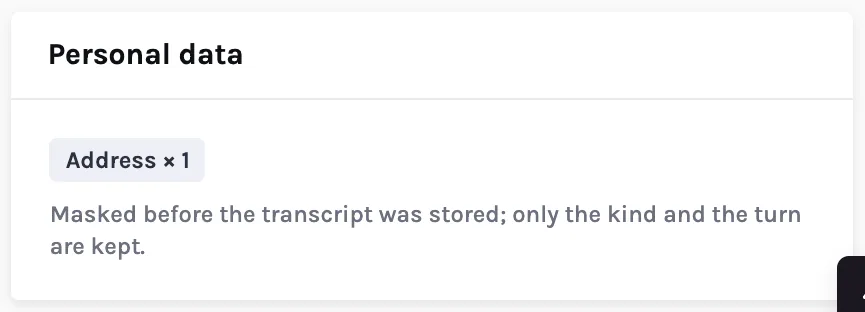
- What it keeps about what it masked is the kind and the turn, never the value. The call page shows both: a masked token in the transcript, and a count by kind in the Personal data panel.
- Live calls are masked turn by turn as they arrive. With Amazon Transcribe, the speech-to-text step applies its own PII redaction as well, so the text is cleaned twice before anyone reads it.
Why transcripts are a data-protection problem
A contact-centre call is a conversation in which the customer is constantly asked to prove who they are. They spell their email, read their card number, confirm their address. Turn that into text and you have a document full of exactly the data your security team works hardest to protect, now searchable, exportable and read by QA, coaching, fraud and insight teams.
Recordings have always carried that risk, but a recording is hard to search. A transcript is easy to search, copy and quote, and call intelligence exists to quote it. So the masking has to happen before the transcript is stored, not as a view filter on top of it.
Where masking happens
Every call reaches InsightCallIQ through one path, whatever its source: an uploaded transcript, a recording run through speech to text, a batch from your storage bucket, or a live stream. On that path, the transcript is turned into speaker turns and every turn is masked before any analysis or storage.
One masking step on every route in. The analysis reads the masked text, and only the masked text is stored.
That ordering matters. QA scoring, compliance checks, fraud patterns, coaching clips, the copilot's answers and the exported decision record all work from the stored, masked turns. There is no second, unmasked copy for a downstream feature to leak.
What gets masked
The masking is deterministic: patterns, with validation wherever the format has one, so ordinary numbers in a conversation (an amount, a reference, the last four digits of a card) are not swallowed by accident.
| Kind | Masked when | Token in the transcript |
|---|---|---|
| Card number | a long run of digits with a card issuer's leading digit and a valid Luhn check | [CARD] |
| Phone number | a US number written with a separator or brackets, or an international number with a country code | [PHONE] |
| an address of the form name@domain, ignoring image-style file names | [EMAIL] | |
| US Social Security number | the dashed form with a valid area, group and serial, or nine digits right after “SSN” or “social security” | [SSN] |
| IBAN | a country code, check digits, the country's length and a valid mod-97 check | [IBAN] |
| UK National Insurance number | valid prefix letters, six digits and a suffix letter | [NI] |
| Date of birth | a date that follows “date of birth”, “DOB” or “born” in the same turn | [DOB] |
| Address | a US street line (number, name and street type) or a UK postcode | [ADDRESS] |
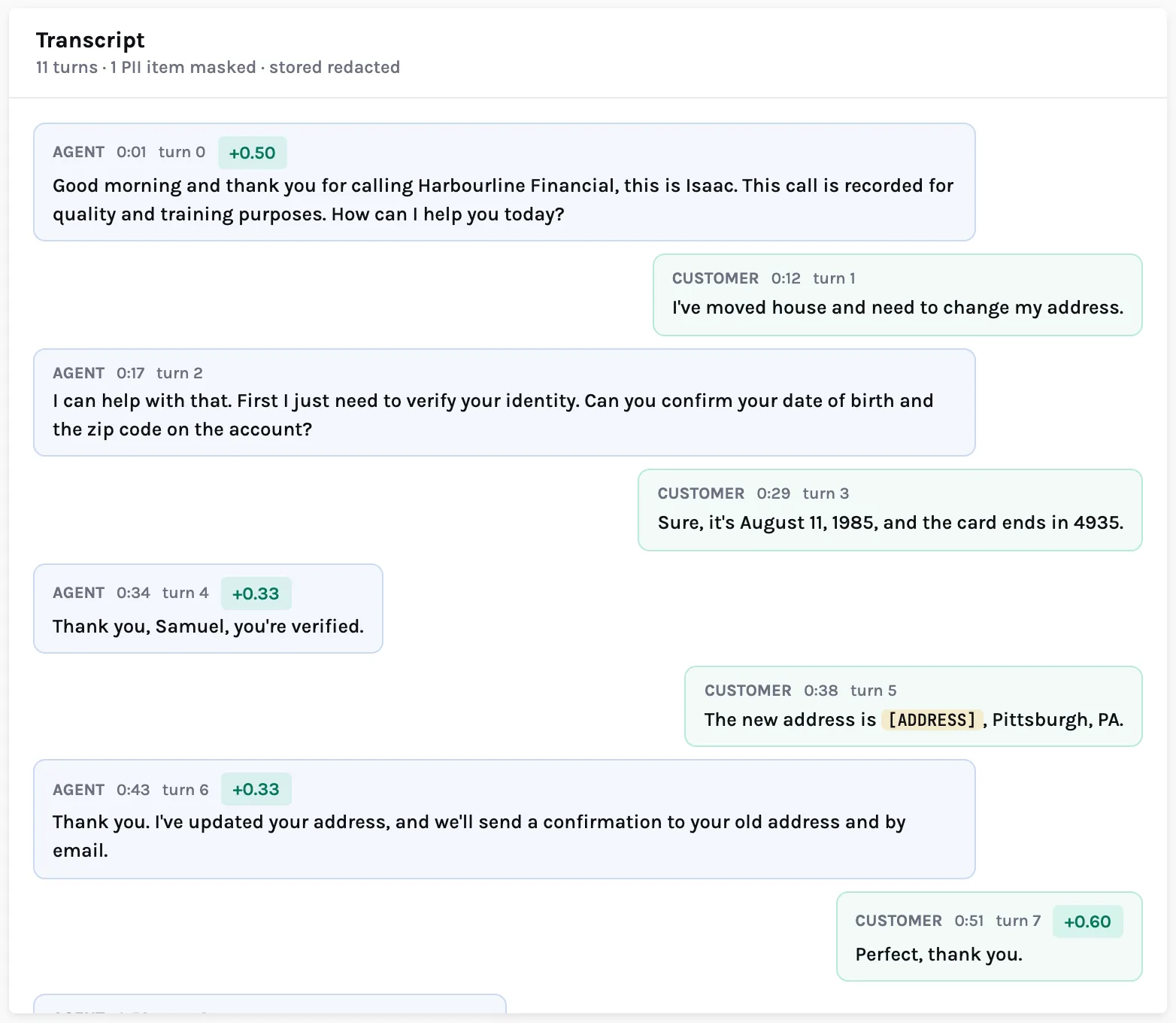
Two examples from the fictional Harbourline Financial demo show the result. In an account-change call, the customer gives a new street address; in the stored transcript it reads “The new address is [ADDRESS], Pittsburgh, PA.” The town stays, because the town is what the agent and the fraud model need. In the demo's takeover call, the caller dictates a new email for the one-time passcode; it is stored as [EMAIL], while the request itself, “Send the code to my new email”, stays readable for the fraud model to quote.
Keeping the kind, never the value
Masking throws the value away, but it keeps a small, useful record: for each mask, the turn it was in and the kind of data. That record is what the call page's Personal data panel shows, and it is enough to answer the questions a compliance team asks. Did customers read card numbers on calls this week? Which calls carried an address change? On which turn?
It also makes the masking itself auditable. The ingest record for every call notes how many items were masked, so a sudden drop to zero on a channel that usually carries card numbers is something an engineer can notice and investigate.
Speech to text: masked twice
When InsightCallIQ turns a recording into text with Amazon Transcribe, batch or streaming, it asks for Transcribe's PII content redaction, which is on by default in the product's set-up alongside speaker labels and channel identification. The text that comes back is already redacted, and then it goes through InsightCallIQ's own masking like every other transcript. With Whisper (batch clips of phone audio), the product's own masking does the work. Either way the stored transcript is masked by the same rules.

Live calls
During a live call, the transcript arrives turn by turn from Twilio Media Streams or Amazon Connect, and each turn is masked as it arrives, before it is added to the live session. The agent's assist panel, the supervisor's wallboard and the running checks all read masked text. When the call ends, the after-call summary and the draft wrap-up note are written from the masked turns too.
And the recordings themselves
InsightCallIQ is built to keep recordings where they already are. A batch from storage is read from your bucket without changing it; the call keeps a pointer to the recording, and the masked transcript and its analysis live in InsightCallIQ's own schema. Your existing controls on the recording store (who can listen, how long audio is kept, where it is held) continue to apply, and the product runs in your own cloud account: AWS, Google Cloud or Azure, so transcripts stay in the same account and region as the audio.
Transcripts are stored in full and masked when a screen shows them. Every new report, export or integration has to remember to mask, and one that forgets leaks.
Every turn is masked before analysis and storage. Scores, quotes, coaching clips, the copilot and exports all read the masked text, because there is no other.
Checklist for security and privacy teams
Uploads, an S3 batch, Twilio Media Streams or Amazon Connect. Every route goes through the same masking step.
With Amazon Transcribe, PII redaction is on in the product's set-up; keep it on. Speaker labels and channel identification give clean agent and customer turns.
Ingest a handful of real calls in a test account and open each call's Personal data panel. The kinds and counts should match what you hear on the recordings.
Roles decide who sees transcripts, reviews and exports; viewers and auditors read and change nothing. Recording access stays with your recording store.
The ingest record counts masked items per call. A channel whose count changes sharply is worth a look.
Personal data should be gone before anyone can read the transcript.
InsightCallIQ masks every turn on the way in, keeps only the kind and the turn of what it masked, and analyses the masked text. QA, compliance, fraud and coaching all work, and none of them needs the card number to do it.
Where people stay in charge
- A person decides every review: a compliance breach, a fraud alert, a QA dispute, a complaint or a vulnerable customer. When the controls refer it, a lead who did not submit it decides.
- Agents prepare and ask first: every agent action is capped at L2, so a wrap-up note, a calibration request, a watch-list entry or a weekly brief waits for a person to accept it.
- Every score is the engine's: points come from the scorecard's weights and the risk model's reasons, and a drafted sentence with a figure outside the call's facts is thrown away.
- A QA answer stands on a quote: a model answer whose quote is not word for word in the transcript is rejected, and the scorecard's own check stands.