In short
- A QA answer is only as useful as the evidence behind it. Without the words it rests on, every disagreement becomes an argument about impressions.
- In InsightCallIQ every scorecard answer carries a quote and a turn number, and the quote is the transcript’s own words.
- When a language model proposes an answer, the answer is kept only if its quote is word for word in the turn it names, and its reason carries no number the call does not contain. Otherwise it is rejected, listed, and the engine’s answer stands.
- Disputes get faster because they are about one answer and one quote, and a lead who did not raise the dispute decides it.
“Empathy: no.” Every QA team has had the conversation that follows. The agent says they were kind. The analyst says they were not kind enough. Neither can point at anything, so it ends with the more senior person’s view, and the agent learns that QA is a matter of opinion.
InsightCallIQ is built on one rule that ends that conversation before it starts: a QA answer must quote the call. Not paraphrase it, not summarise it; quote it, with the turn number, so anyone can open the transcript and see the words. This post explains why that rule matters, how it works for answers the engine reaches and for answers a language model proposes, and what it does to disputes. The examples come from the fictional Harbourline Financial demo.
Three reasons the quote matters
It makes the answer checkable
A score that says “no” and quotes turn 6 can be checked in seconds: read turn 6, read the next agent turn, agree or disagree. A score that says “no” with a comment like “tone could be warmer” can only be accepted or argued with. Checkability is what lets a QA programme scale beyond the people who wrote it.
It makes the answer coachable
An agent cannot change an impression, but they can change a sentence. A quote shows the moment that mattered and what was said instead, which is exactly what a team lead needs for a five-minute coaching conversation.
It makes automation safe
Language models are good at reading conversations and bad at admitting they did not find something. A model asked “did the agent show empathy?” will sometimes answer with a sentence that sounds right and was never said. If the answer must quote the call, that failure becomes detectable: the quote is either in the transcript or it is not.
What the evidence looks like on a call
Here is a Harbourline card-services call scored on the Service quality scorecard. Each row is a criterion; the right-hand column is the evidence. A yes quotes the sentence that carried the required phrase. A no quotes the turn that shows the gap. A rule that is met by absence, such as “no prohibited language”, says what was checked: “Checked: not found in the call”.
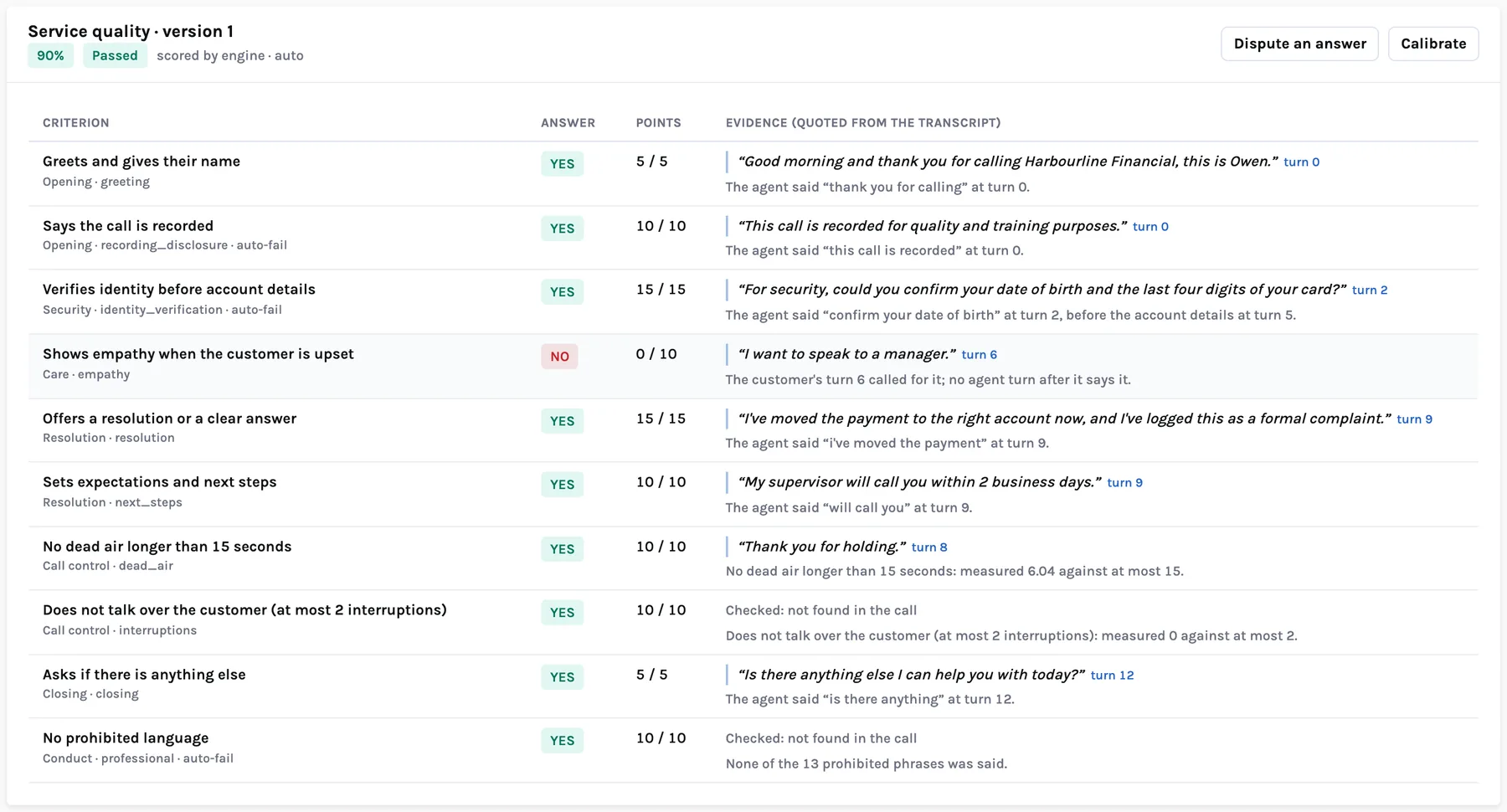
The quote is not a free-form excerpt. InsightCallIQ finds the phrase that satisfied the criterion and quotes the sentence that carries it, exactly as it is written in the turn. For a no, it quotes the turn that defines the gap: the customer’s upset turn for empathy, the turn with account details for identity verification, the last turn inside the time window for a required statement that never came.
| Answer | What is quoted | What the reason says |
|---|---|---|
| Yes | the sentence that carries the phrase | The agent said “confirm your date of birth” at turn 2, before the account details at turn 5. |
| No, the condition arose | the customer turn that called for it | The customer’s turn 6 called for it; no agent turn after it says it. |
| No, said too late or never | the last agent turn inside the window | No agent turn in the first 45 seconds says it; the last one is quoted. |
| Yes by absence | nothing, by design | Checked: not found in the call. |
| Not applicable | nothing | The condition did not arise on this call. |
When a model proposes an answer
InsightCallIQ’s scorecards are answered by a deterministic engine first. A language model can be switched on to propose answers for criteria that benefit from reading the whole conversation, and the QA scorer agent is instructed to answer yes, no or not applicable and to quote the exact words of the turn it relies on, with the turn number.
Every proposal then goes through the same check before it can replace the engine’s answer:
The model proposes; the evidence check decides whether the proposal may stand.
- The answer must be yes, no or not applicable. Anything else is rejected.
- The quote must be in the turn it names. The comparison ignores case and spacing, and nothing else. A paraphrase, a quote from a different turn or a turn number outside the call is rejected.
- The reason may not carry an outside number. If the model’s explanation mentions a figure that is in neither the transcript nor the call’s facts, the answer is rejected.
- The points are never the model’s. Whatever the source of the answer, the points come from the scorecard’s weights, and the arithmetic is the same.
A rejected answer is not hidden. It is listed beside the score with the reason it was rejected, and the QA overview counts rejected model answers per scorecard, so a QA lead can see at a glance whether the model is earning its place on a criterion. In the Harbourline demo the model is switched off, so the engine answers every criterion and the count reads zero.
The same rule holds for the call reason
Conversation analytics classifies why the customer called from a weighted phrase lexicon. If a model is switched on to propose the reason, its proposal is used only if it is one of the known reasons and quotes a turn word for word; otherwise the lexicon’s answer stands, and the call records that the model’s reason was set aside.
Disputes become short
Because every answer has a quote, a dispute is about one answer and one quote, not about the call as a whole. From the scorecard, a person chooses Dispute an answer, names the criterion, says what the answer should be and why. That opens a QA dispute review.

Say which criterion, the proposed answer and the reason. The disputed answer’s quote travels with the review.
Open the call at the quoted turn. Most disputes are settled here: the words either support the answer or they do not.
InsightCallIQ refuses a decision from the person who raised the dispute. The decision record keeps who raised it, who decided and why.
An upheld dispute revises the answer, marks it as a person’s, and rescores the call. A dismissed one leaves the score as it was.
Calibration works the same way in the other direction. When an analyst calibrates a score, they answer the criteria themselves; InsightCallIQ records the agreement between the analyst and the automatic answers, criterion by criterion, and keeps the differences. Over time those differences show where a criterion’s wording needs work.
What this asks of the scorecard author
Quoting the call is a discipline for the people who write scorecards, too. A criterion that cannot be evidenced from the transcript, such as “sounded confident”, does not belong on a scorecard that agents are measured against. In practice that pushes scorecards towards criteria that are both fair and teachable:
- Name the words. “Gives the debt-collection disclosure” with the exact phrases is better than “handles disclosures properly”.
- Say when it applies. Empathy is required when the customer was upset; an empathy criterion that applies to every call punishes agents on calm calls.
- Use a measurement where one exists. “No dead air longer than 15 seconds” is a measured fact; “kept the call moving” is an impression.
- Keep auto-fail for the few things that really are. Recording notice, identity before account details, prohibited language. An auto-fail sets the score to zero and keeps the raw percentage beside it.
The agent cannot see what to change, the lead cannot check the answer, and a model could have written the same sentence about any call.
The quote is on the page, the rule is explicit, and the agent knows exactly which moment to replay in coaching.
If the answer cannot point at the call, it is not an answer.
InsightCallIQ treats the transcript as the only source of truth for QA. The engine quotes it, a model must quote it, and a person deciding a dispute reads it. That is what makes scoring every call something agents can trust.
Where people stay in charge
- A person decides every review: a compliance breach, a fraud alert, a QA dispute, a complaint or a vulnerable customer. When the controls refer it, a lead who did not submit it decides.
- Agents prepare and ask first: every agent action is capped at L2, so a wrap-up note, a calibration request, a watch-list entry or a weekly brief waits for a person to accept it.
- Every score is the engine's: points come from the scorecard's weights and the risk model's reasons, and a drafted sentence with a figure outside the call's facts is thrown away.
- A QA answer stands on a quote: a model answer whose quote is not word for word in the transcript is rejected, and the scorecard's own check stands.